
Prasad Is Out. Biotech Is Moving. Here's What Actually Matters.
- Mar 10
- 6 min read
March 9, 2026 | R¹E Research
What Vinay Prasad's FDA Exit Means — and Why R¹E Had Already Been Tracking These Names
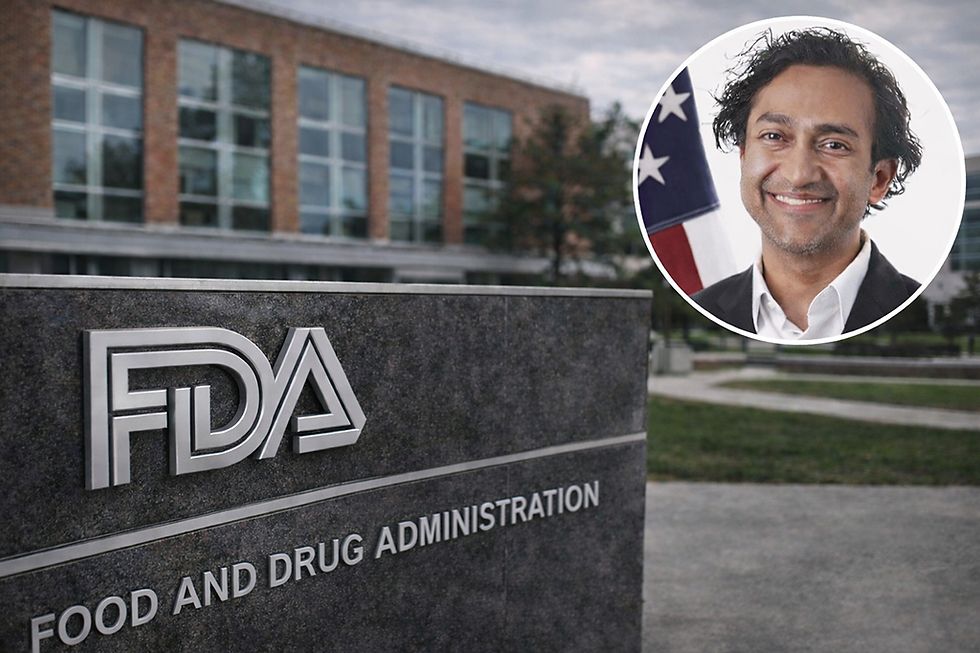
On Friday, March 6, FDA Commissioner Marty Makary confirmed that Dr. Vinay Prasad — director of the Center for Biologics Evaluation and Research (CBER) — will depart the agency at the end of April. It was his second exit from FDA leadership in under a year. By Monday morning, the market had already rendered its verdict: uniQure (QURE) surged more than 36%. REGENXBIO (RGNX) gained over 18%. Biohaven (BHVN) rose 23%. The XBI moved sharply higher across the gene therapy and rare disease complex.
Several signals had already been emerging beneath the surface. R¹E had been closely tracking a number of these names as the regulatory picture evolved.
Who Was Vinay Prasad — and Why Did His Exit Move Markets?
Dr. Prasad served as CBER director, overseeing the regulation of gene therapies, vaccines, and biologics. During his tenure, he became one of the most consequential — and most contested — figures in biopharma regulatory history.
His decisions reflected a genuine philosophical commitment to stricter evidence standards: demanding larger, controlled Phase 3 trials even for rare diseases where traditional randomized controlled trials are logistically near-impossible and patient populations are vanishingly small. For some, this represented scientific rigor. For companies and patients waiting on potentially transformative therapies, it represented a structural barrier with real clinical consequences.
The friction was concrete and well-documented:
uniQure (QURE): Prasad's CBER demanded a new Phase 3 trial for AMT-130, a Huntington's disease gene therapy, including a sham surgery control arm — a requirement widely viewed by the gene therapy community as scientifically disproportionate and ethically complex. QURE surged more than 36% on the exit news.
REGENXBIO (RGNX): Received a Complete Response Letter for RGX-121 in Hunter syndrome (MPS II), with the FDA citing concerns about the validity of external natural history controls — a methodology RGNX had aligned with the agency on during development. RGNX gained over 18% this week.
Sangamo Therapeutics (SGMO): Advancing a rolling BLA for ST-920 in Fabry disease with an FDA-agreed accelerated approval pathway. That pathway is now advancing into a materially more favorable regulatory climate.
Moderna (MRNA): Experienced a significant review delay for its mRNA flu vaccine BLA under Prasad's leadership — a decision that contributed to broader sector anxiety about the direction of CBER under his tenure.
William Blair analyst Matt Phipps captured the market's interpretation clearly: Prasad's departure is "likely a tailwind for the biotech sector, particularly in cases of regulatory flexibility for companies developing novel therapies for rare diseases."
Why This Is Bigger Than One Regulator
Prasad's exit does not resolve all uncertainty. His replacement has not yet been named. The FDA continues to navigate significant institutional pressure across multiple divisions. Regulatory leadership volatility remains a meaningful risk factor for the sector and should not be dismissed.
But the structural shift is significant. The specific regulatory posture that created headwinds for single-arm studies, external natural history controls, and accelerated approval pathways — the methodologies most relevant to rare disease and gene therapy sponsors — was tied directly to Prasad's philosophy and his personal review of specific dossiers. That posture is now in transition.
For companies in gene therapy, rare disease, and biologics: the approval pathway visibility just improved in a measurable way.
What R¹E Had Already Been Tracking
R¹E research had been monitoring several of these names well before this week's catalyst. Our approach does not follow headlines — it identifies scientific differentiation, regulatory risk/reward asymmetry, and capital structure, with the goal of recognizing inflection points before they are broadly priced in.
Three names in our active coverage are directly relevant to this week's development:
REGENXBIO (RGNX)
R¹E had been covering RGNX in the context of the RGX-121 Complete Response Letter and the broader question of what a post-Prasad CBER would mean for sponsors using external natural history datasets. With pivotal topline data for RGX-202 in Duchenne muscular dystrophy expected in early Q2 2026, a potential BLA filing in mid-2026, and the Hunter syndrome resubmission path now potentially unblocked, RGNX is entering a period of compounding catalysts. This week's move reflects sentiment normalisation. The next six months reflect the science.
IMUX — Immunic Therapeutics
R¹E published our full investment thesis on IMUX: the only oral MS candidate in Phase 3 targeting neurodegeneration directly, through dual DHODH inhibition and Nurr1 activation — mechanisms that no approved oral MS therapy currently possesses. With $200M raised in February 2026, Immunic is fully funded through Phase 3 readout and potential NDA submission without needing to return to capital markets. IMUX does not sit within CBER's jurisdiction — but a market that has been broadly discounting innovative therapy risk is a market that has been applying an unwarranted regulatory discount to names like this one. As that discount normalises, the setup improves. The Phase 3 ENSURE-1 and ENSURE-2 programs — 2,221+ patients across 15 countries — remain on track for a synchronized year-end 2026 readout. At $1.24 today, the risk-adjusted return profile remains compelling for appropriately sized positions.
SGMO — Sangamo Therapeutics
Today, March 9, Sangamo advanced its rolling BLA submission to the FDA for ST-920 in Fabry disease. The STAAR registrational study demonstrated a positive mean annualized eGFR slope at 52 weeks — a primary endpoint the FDA explicitly agreed may support accelerated approval. Clinical and preclinical modules have now been submitted. With a clearly defined regulatory pathway and CBER entering a new leadership chapter, ST-920's route to approval has become materially easier to model. R¹E has been following this submission closely as a near-term catalyst.
Investor Takeaway
Three dynamics now define the gene therapy and rare disease regulatory outlook following this transition:
Potential easing of evidence thresholds for rare diseases. The specific demand for randomised controlled trials in ultra-rare populations — historically untenable — is likely to receive more nuanced treatment under new CBER leadership.
Renewed viability of external natural history controls. The methodology that underpinned several recent CRLs, including RGNX's RGX-121 rejection, was a direct expression of Prasad's evidence philosophy. That philosophy is departing with him.
Improved approval visibility for single-arm studies in accelerated pathways. For sponsors with FDA-agreed endpoints and meaningful clinical datasets, the probability-weighted path to approval just became easier to underwrite.
If these dynamics hold, several previously discounted programs could see material re-rating across the sector. The companies best positioned are those with strong underlying science and FDA engagement already in place — not those entering regulatory conversations from scratch.
The Broader Framework: Regulatory Alpha
What this week illustrates — again — is that regulatory inflection points are among the most underappreciated sources of return in biopharma investing. Most market participants react to regulatory events after they occur. A smaller group anticipates them by reading the regulatory docket, tracking FDA correspondence and advisory committee dynamics, and understanding the specific mechanisms by which a given drug or modality interacts with the agency's current posture.
When Prasad was appointed in May 2025, the biotech sector sold off sharply. The signal was clear then: his mandate would create specific, identifiable headwinds for gene therapy and rare disease sponsors. The corollary was equally clear — and we began closely tracking several of these names as the regulatory picture evolved.
What Comes Next
The search for Prasad's replacement is underway. Commissioner Makary has committed to naming a successor before April's end. The orientation of that appointment — scientific background, prior FDA experience, posture toward novel trial designs — will define the second-order regulatory story for the remainder of 2026. R¹E will be publishing our read on the implications as soon as the appointment is confirmed.
In the meantime, the names we have been tracking — RGNX, IMUX, SGMO, and several others in our active pipeline — remain in focus.
R¹E research is built on one principle: identify inflection points before they are broadly priced in.
If you are an investor, founder, or institutional allocator looking to stay ahead of the next regulatory or scientific inflection point in biotech, we want to hear from you.
Contact us at research@r1-e.com or visit r1-e.com to request our full research briefs.
This article is for informational purposes only and does not constitute investment advice. Past coverage of a security does not guarantee future performance. R¹E = Research to Execution. Luxembourg.


